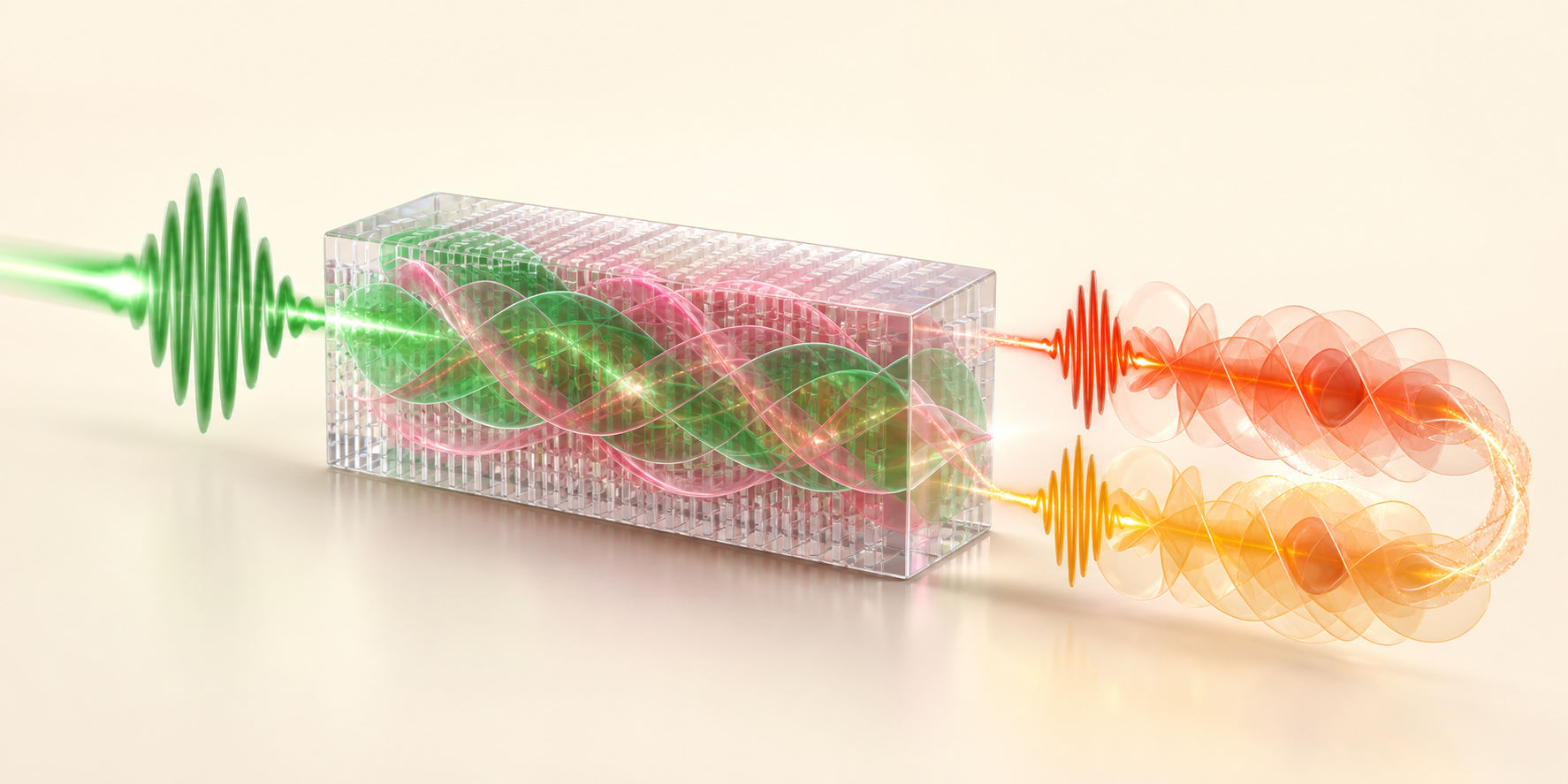
Programming spontaneous down-conversion
In spontaneous parametric down-conversion, a pump photon is converted into a correlated signal–idler pair. The process naturally produces entanglement across spatial, spectral, polarization, and temporal degrees of freedom. Our work treats these correlations as a design space: structure in the pump field and the nonlinear susceptibility is transferred into the biphoton wavefunction, allowing the source itself to prepare the desired quantum state.
We developed a nonperturbative simulation framework for structured SPDC that predicts both single-photon intensities and two-photon coincidence patterns. It captures complex pump beams and two-dimensional nonlinear photonic crystals, reveals the associated modal conservation rules, and provides the forward model needed to move from analyzing photon-pair sources to designing them.
Inverse-designed high-dimensional entanglement
High-dimensional photonic qudits offer a larger information space per photon, but producing a prescribed state directly is difficult because its coefficients depend jointly on diffraction, phase matching, pump structure, and the nonlinear medium. We introduced a differentiable inverse-design method that starts from a target biphoton state and optimizes experimentally accessible source parameters to realize it.
The framework combines physical propagation equations with gradient-based optimization, enabling the design of spatially entangled states in chosen mode bases. We subsequently brought this idea into the laboratory by shaping the pump as a superposition of radial and azimuthal Laguerre–Gaussian modes. The experiment generated maximally entangled qubit and qutrit states, verified their entanglement through generalized Bell tests, and demonstrated their use in a proof-of-principle high-dimensional quantum-key-distribution protocol.
Entangled states directly from the source
Source engineering can eliminate lossy interferometric preparation stages by generating the desired path-entangled state within the nonlinear interaction itself. We demonstrated two compact routes to bright two-photon N00N states: shaping the pump beam and structuring the nonlinear coefficient of the crystal. Both approaches coherently direct the down-converted amplitudes into the required paths.
The resulting source combines strong photon-pair flux with the phase sensitivity of path entanglement. Two-photon interference exhibits fringes at half the optical wavelength, highlighting how structured nonlinear optics can translate a designed interaction directly into a quantum-metrology resource.
Shaping bright squeezed vacuum
At high parametric gain, down-conversion produces bright squeezed vacuum: a macroscopic multimode quantum field whose useful correlations are distributed across many spectral modes. We use nonlinear holography to engineer those correlations in the frequency domain, extending source design from individual photon pairs to continuous-variable quantum states.
By tailoring the longitudinal nonlinear interaction, the method can sculpt squeezing over two-dimensional frequency lattices and synthesize the correlations required for cluster states. The approach connects ultrafast nonlinear optics with scalable continuous-variable quantum information, with the pump and nonlinear grating serving as all-optical controls over the generated quantum network.