Photonic circuits that learn from light
High-dimensional optical states can encode information across many spatial, spectral, or temporal modes. This richness supports quantum communication, sensing, and continuous-variable computation, but it also creates a practical bottleneck: the physically generated modes are rarely the natural modes in which the state is simplest or most useful. Conventional characterization first reconstructs a large matrix and then computes its modal decomposition. As the number of modes grows, both measurement overhead and circuit complexity can become prohibitive.
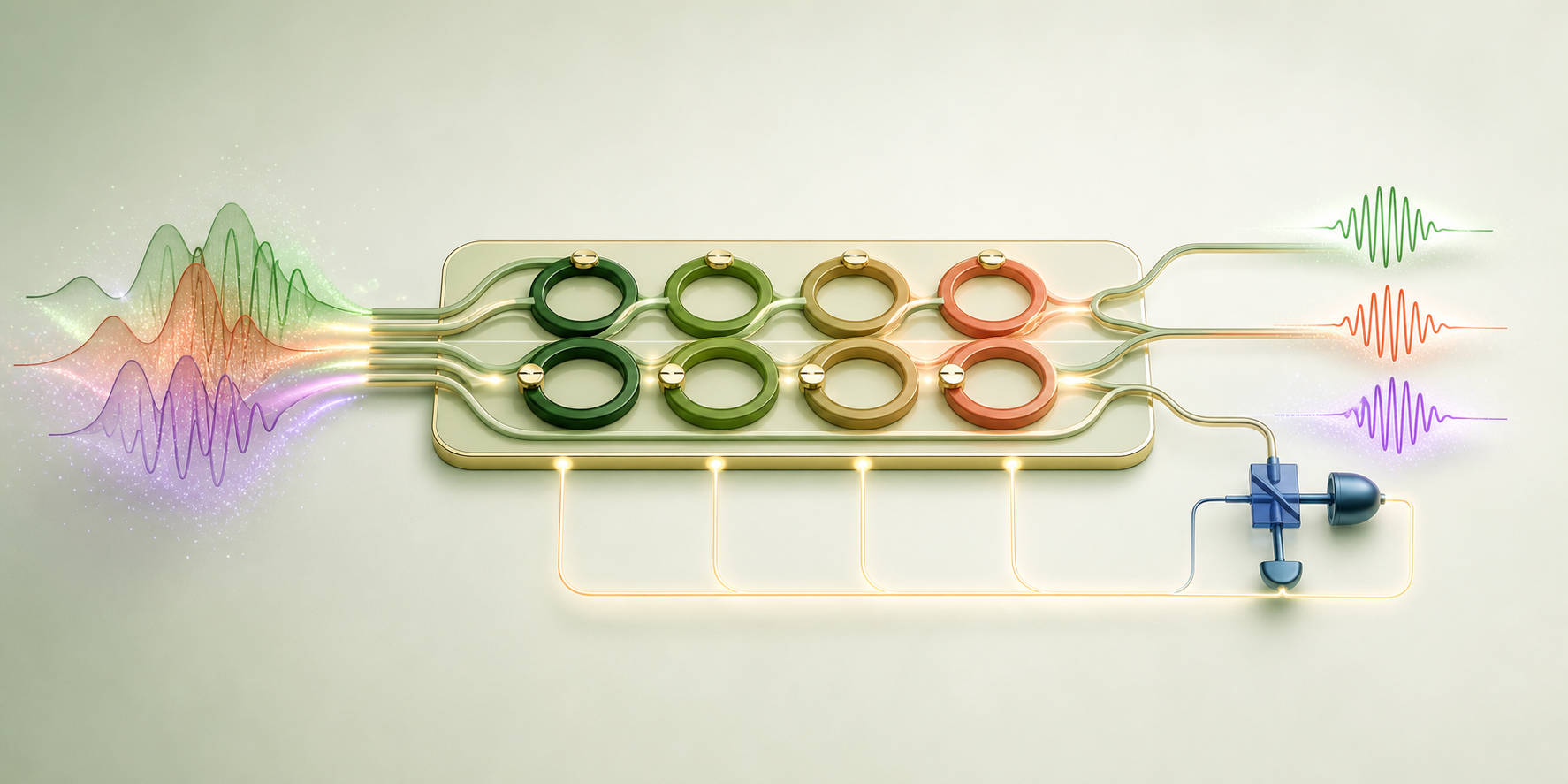
Our research develops an alternative based on self-configuring photonic networks. Instead of treating the circuit as a fixed transformation that must be calibrated in advance, we allow it to learn directly from optical measurements. Tunable interferometers are adjusted through feedback so that successive circuit layers identify significant modes and route them to designated outputs. The device becomes an analyzer, demultiplexer, and processor. The common idea is variational: define an accessible signal whose optimum corresponds to a meaningful optical mode, then let the circuit find that optimum in situ.
Learning the modal structure of entanglement
For a pure bipartite quantum state, the Schmidt decomposition identifies pairs of orthogonal modes and their weights, exposing both the structure and dimensionality of entanglement. Although this decomposition is fundamental in theory, extracting it experimentally for an unknown high-dimensional state is difficult. In Automated Modal Analysis of Entanglement with Bipartite Self-Configuring Optics, we proposed coupled self-configuring networks that learn the Schmidt modes of the two subsystems automatically.
The method optimizes measured output powers or photon-coincidence rates layer by layer. Each optimized layer isolates one Schmidt-mode pair; subsequent layers work in the remaining orthogonal subspace. The recovered outputs therefore provide the modal shapes and Schmidt values needed to quantify entanglement. Numerical examples treat spectrally entangled photon pairs generated by spontaneous parametric down-conversion, while the analysis also addresses loss, impurity, and other optical degrees of freedom.
Variational processing of squeezed light
Multimode squeezed light stores its reduced quantum noise in special superpositions called squeezed supermodes. Accessing those supermodes is essential if squeezing is to be routed into sensing channels, communication links, or continuous-variable processors. A general full decomposition, however, requires resources that scale quadratically with the number of physical modes.
In Variational Processing of Multimode Squeezed Light, we introduced a sparse self-configuring network that discovers the most strongly squeezed supermodes first. Homodyne detection supplies the cost function: by optimizing the measured quadrature variance, each circuit layer learns one supermode and directs it to a separate output. If only the leading modes are needed, the architecture reduces both the optical hardware and the number of optimization steps.
Experimental separation of coherence modes
Separating Partially Coherent Light tests the same self-configuring principle in an integrated experiment. A layered interferometer implemented on a silicon photonic circuit automatically finds the eigenvectors and eigenvalues of the input coherency matrix. In physical terms, it separates a partially coherent field into orthogonal, mutually incoherent coherence modes while leaving those modes available at distinct outputs after optimization.
The experiment samples partially or fully overlapping fields from two independent lasers across nine spatial modes and recovers the two strongest coherence modes. Electronic drive-frequency multiplexing enables in situ gradient optimization of the interferometer phase shifters. The demonstrated hardware scales linearly with the rank of the coherency matrix and is benchmarked against a mixture-based tomographic method on the same chip.