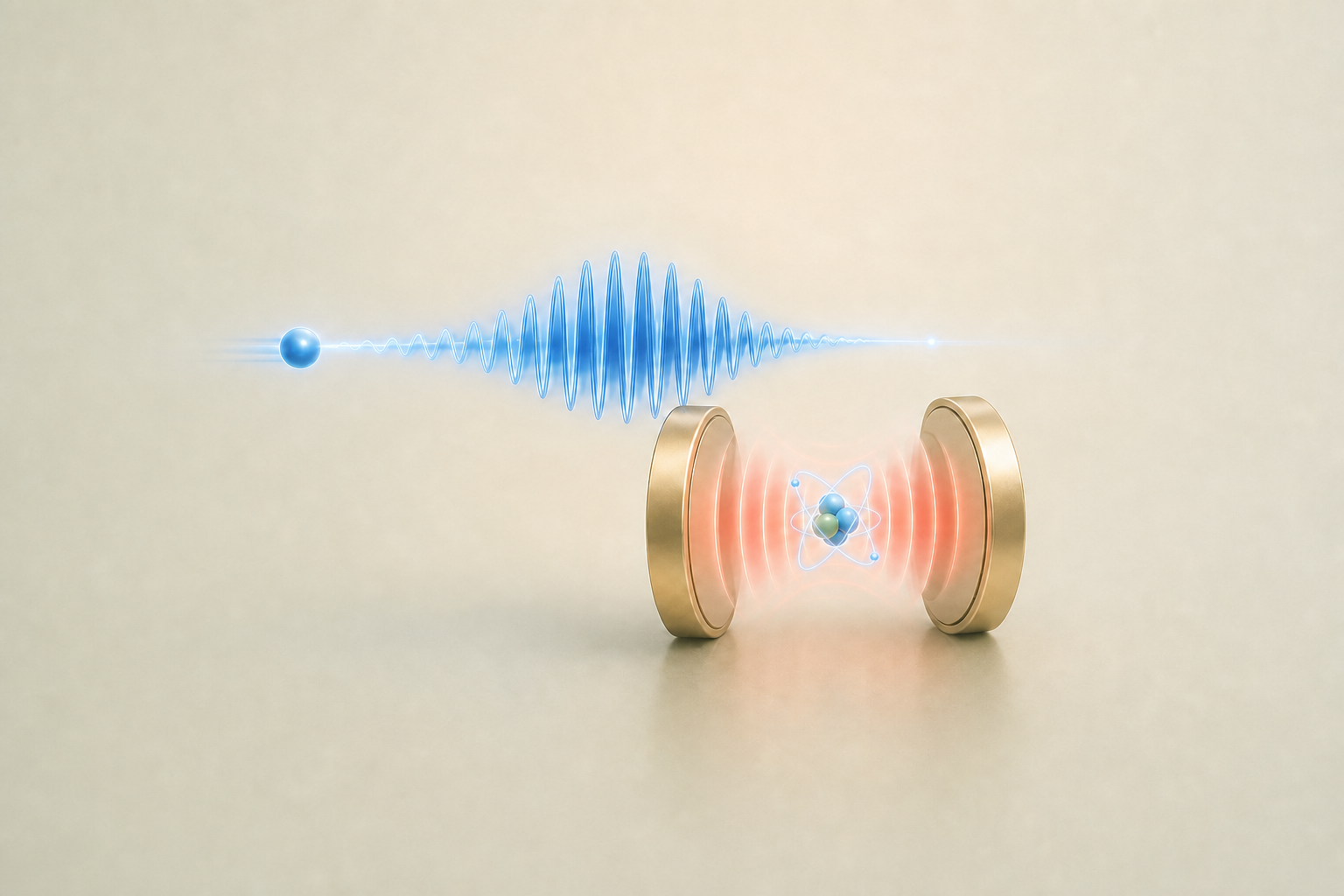
Free electrons as quantum systems
Free electrons are usually described as probes or sources: they image matter, lose energy to optical excitations, and generate radiation. At the quantum level, however, an electron is also a coherent matter wave whose energy, phase, recoil, and correlations can be engineered. Free-electron quantum optics asks what becomes possible when both the electron and the electromagnetic field are treated quantum mechanically.
This viewpoint changes the questions we ask. Instead of considering only how much radiation an electron emits, we examine the joint electron–photon state produced by the interaction. The discrete exchange of photon quanta creates correlations between the electron’s energy ladder and the photon-number ladder. Electron shaping and measurement then become tools for controlling light, while optical and material environments can be designed to control or read out the electron.
Our Nature Physics Perspective organizes this emerging field around interactions among free electrons, photons, and bound quantum systems. It also identifies electron microscopy as a natural setting for quantum optics, combining subwavelength spatial resolution, ultrafast dynamics, and access to electron energy and wavefunction degrees of freedom.
Quantum coherence in electron radiation
A central part of our work examines how the quantum state of an emitting electron appears in the light it produces. We showed that optical coherence is fundamentally related to the quantum coherence of the emitting particle. Depending on recoil and momentum uncertainty, different components of the electron wavefunction can become distinguishable through the emitted photon, changing the optical coherence even in regimes often treated classically.
The same principle extends to multiple electrons. Path-entangled electron pairs can emit superradiantly or subradiantly depending on their joint Bell state. Their radiation therefore carries information that cannot be reproduced by a classical mixture with the same single-electron properties. This establishes emission as a possible probe of many-electron coherence and entanglement.
Creating and measuring quantum light
Because electrons and photons become correlated during their interaction, electron preparation and post-selection can reshape a photonic state. We developed a quantum description of consecutive electron–cavity interactions and showed how shaped electron energy combs implement displacement operations on light. Measuring electron energy can herald photon-added states or prepare selected Fock states, while repeated interactions provide a route toward broader control of photon statistics.
The complementary problem is to infer an unknown optical state from the outgoing electron. In electron homodyne detection, a shaped electron provides a phase-sensitive probe of quantum light. The electron spectrum can encode the optical density matrix, suggesting photonic quantum-state tomography with femtosecond temporal and nanometre spatial resolution. Together, state preparation and tomography make the electron a bidirectional interface that can both write quantum information into light and read it back.
Cavity quantum electrodynamics
We also investigate regimes in which a free electron interacts coherently with a cavity or with hybrid light–matter excitations. A shaped electron passing a strongly coupled emitter–cavity system can couple through both its photonic and material components. Interference between these pathways makes the electron sensitive to coupling phases, emitter position, dipole orientation, and the quantum state of the resulting polariton.
At lower electron energies, quantum recoil becomes a resource. After emitting one cavity photon, the recoiled electron can be shifted out of resonance, suppressing a second emission. This realizes an effective Jaynes–Cummings interaction between a nominally unbound electron and a cavity photon, enabling deterministic single-photon and photon-pair generation and coherent electron–photon state transfer.
Strong interaction remains a practical challenge because electron diffraction limits the usable interaction length. Our free-electron-fiber proposal addresses this by using one guided optical mode to confine the electron through a ponderomotive potential while a second mode supplies the quantum interaction, substantially extending the co-propagation distance.
Flying qubits and quantum technologies
The electron’s mobility, tunable kinetic energy, and ultrafast transit time make it a natural flying quantum system. In nonlinear cavity QED, we introduced a free-electron–polariton blockade in which the electron interacts resonantly with a hybrid excitation while the cavity nonlinearity suppresses unwanted transitions. The resulting gates are theoretically deterministic and can operate below the characteristic dissipation time of the cavity.
This mechanism supports a universal gate set for polaritonic qubits and schemes for producing entangled photonic graph states. More broadly, our current work develops unified descriptions of electron beams interacting with quantized bound systems in arbitrary electromagnetic environments. These proposals span different experimental regimes, and several remain theoretical. Their common aim is to make the free electron an active quantum resource: a tunable emitter, microscopic sensor, ancilla for photons and matter, and carrier of quantum information between photonic structures.